All
across the country, college and university administrators are raising the
roof—green roofs, that is. They have discovered what a number of people involved
with municipal construction know: green roofs are frequently worthwhile
investments of funds for both new construction and retrofit
projects.
Campus
buildings with green roofs include the McIntyre School of Commerce at the
University of Virginia (UVA). The new building is in a prominent part of UVA’s
campus. Thomas Jefferson would no doubt approve of using nature to make his
university both functional and more beautiful.
Cornell
University replaced an outdated dormitory with the green-roofed Alice H. Cook
House, which was the first LEED [Leadership in Energy and Environmental
Design]-certified residence hall in New York. The University of Florida’s
Charles R. Perry Construction Yard Building has a green roof covering 2,600
square feet. By this fall, the Stephen M. Ross School of Business at the
University of Michigan will have a 20,000-square-foot green roof covered with 12
varieties of sedum plants.
The
Radian, a privately owned student-housing complex at the University of
Pennsylvania, is scheduled for completion in August. Its 12,000-square-foot
green roof will adjoin an outdoor dining area, enhancing the scene for residents
and their guests. Covering about one-fifth of the available area, the Roofscapes
project was designed to meet Philadelphia’s stormwater
regulations.
Pennsylvania
State University has two green roofs and three more under construction. The
4,700-square-foot green roof over part of the Forest Resources Building helped
the building earn a LEED Silver certification. The 4,500-square-foot roof over a
root cellar by the university’s greenhouses is a research site for horticulture
students who monitor the quality and quantity of stormwater running off of the
roof.
When
the green roofs are installed on the law schools on Penn State’s Carlisle and
University Park campuses, and on the health center at University Park, the
university will have “close to an acre of green roof space,” says Robert
Berghage, associate professor of horticulture at Penn State. That total is “one
of the highest concentrations—perhaps the highest concentration—of green roofs
on any campus in North America,” he adds.
The
increasing interest in green roofs has led a number of universities to establish
centers to conduct research on them. These include North Carolina State
University in Raleigh, Michigan State University in Lansing, Southern Illinois
University in Edwardsville, and Pennsylvania State University in University
Park.
 |
Photo: Michigan State University |
| Green-roofed doghouse for Dr. Bradley Rowe's dogs. The retrofitted green roof makes it much cooer during the summer. |
The
increase in green roofs on campuses shouldn’t be too surprising, for
universities, like cities, have many large buildings with flat roofs. Athletic
stadiums and training buildings, gymnasiums and recreational facilities, parking
garages, dormitories, classroom buildings, and buildings with offices for
faculty and staff provide vast amounts of impervious surfaces for stormwater to
flow across.
Another
reason that green roofs are appealing to universities is that their funds are
limited, so their buildings have to last. Green roofs extend the lives of the
regular roofs beneath them, as they offer protection from wind, water, and
temperature fluctuations.
Sometimes
it’s a persistent student who nudges university officials into approving a green
roof. Such was the case at Carnegie Mellon University in Pennsylvania. Other
times, the green roofs are part of a campus-wide effort to minimize the school’s
impact on the environment, such as at Harvard University’s Green
Campus.
But
pragmatic administrators aren’t committing dollars just on the say-so of
idealistic, environmentally concerned students. They have to look at the costs,
savings, and benefits of all physical installations, including green
roofs.
Increasingly
popular in Europe, particularly Germany, green roofs cost less to install there
than they do in North America. Harvard University’s Green Campus Web site
(www.greencampus.harvard.edu/hpbs/green_roofs.php)
lists costs in Europe as ranging “from $4–$13 per square foot,” compared to
those in the United States “from $10–$25 per square foot.”
“It’s
simply an economy of scale issue,” says William Hunt, assistant professor of
biological and agricultural engineering and an extension specialist at North
Carolina State University. “As more green roofs get installed, the cost will go
down. A green roof industry, replete with media providers and contractors, will
develop and this competition will drive prices down.”
Hunt
adds that as with any new technology, “many folks in certain parts of the
country are uncomfortable with installing them and, therefore, raise their costs
to cover all the ‘unknowns.’”
Berghage
agrees that green roofs “are too expensive right now in North America. I think
the price will come down as we get more built and there are ways to reduce the
overall cost.”
Green
Roofs for Healthy Cities, a nonprofit industry association, has a helpful gauge
for determining how cost effective a green roof, new or retrofit, would be for a
particular building. Its GreenSave Calculator is available online at
www.greenroofs.org.
Extensive
and Intensive Roofs
Green
roofs differ in cost by type. According to the organization Lake Superior
Streams, intensive green roofs cost $16 to $35 per square foot, while extensive
ones run $7 to $35 per square foot. Both types of roofs offer significant
benefits, such as stormwater retention and reduced energy costs, but
differences, chiefly in composition and maintenance, account for the cost
differential.
 |
Photo: Michigan State University |
| Research is being conducted on 48 raised roof platforms at Michigan State University to evaluate stormwater runoff and potential plant species. |
Extensive
green roofs require soil or growing medium no deeper than about 5 inches. While
capable of sustaining many kinds of grasses and ground cover, they are most
often planted in some of the more than 1,000 species of sedum. Attractive,
low-growing sedum is extremely tolerant of drought, yet absorbs water well.
Frost- and wind-resistant, it fills in the area quickly and requires little or
no maintenance.
If
additional weight on the roof is a structural concern and the budget does not
allow for the cost of reinforcing the existing roof, then the growing medium for
the plants will have to be shallow. That means it will dry out faster and be
more affected by fluctuations in temperature. Still, some species of moss and
sedum can grow in very shallow depth. Because they thrive on rocky cliffs in
windy coastal areas, the harsh microclimate of roofs, with wind and temperature
extremes, is not a problem.
Extensive
green roofs have simpler irrigation and drainage systems, further contributing
to low maintenance. Most green roofs, extensive or intensive, need additional
water during the first season or two until the plants are well established. That
requirement can be met by a simple sprinkler system or some form of passive
irrigation, such as cisterns or membranes that store rainwater beneath the
plants.
While
the public can often see extensive green roofs from adjoining buildings, they
are typically not installed in areas with public access. Intensive green roofs,
however, are usually planted with the public in mind. They serve as mini parks,
providing restful landscapes for the public to enjoy.
As
their name implies, intensive green roofs require more effort to establish and
maintain, starting with more soil—at least a foot deep. The more elaborate ones
include large trees, shrubs, and well-established gardens of perennials and
sometimes annuals. These plants are, of course, larger and heavier, and have
more elaborate root systems. The services of gardeners or maintenance workers
and probably a landscape architect are more or less
givens.
With
vegetation of more varieties, irrigation and drainage systems for intensive
green roofs must be more complex and able to handle varying input and output of
water. Regular weeding, irrigating, mowing, pruning, and fertilizing must be
done, just as with a garden on ground level. The amount of fertilizer must be
monitored, so that pollution in runoff is not increased.
Both
types of green roofs use waterproof membranes to protect the building from
leaks. An additional barrier layer protects the membrane against damage by root
penetration. Green roofs work well only if they are installed well. The
University of Oregon found this out the hard way when workers punctured the
waterproof membrane under the new green roof at the state-of-the-art Lillis
Building, part of the university’s School of Business. Finding and repairing the
leak meant removing the soil. The university has two other green roofs, atop the
Native American Long House and the ground-level nanotechnology lab, Lokey
Laboratories.
The
10,000-square-foot extensive green roof that Harvard installed on top of an
existing parking garage and courtyard cost approximately $50 per square foot.
Installed over the existing asphalt roof, it consists of various membranes, root
barriers, a drainage course, and a water retention/drainage/aeration layer. The
roof’s Hydrotech Lite Top growing medium is 4 inches deep in the field, 12
inches deep in shallow planters, and 36 inches deep in the deeper planters. This
extensive type roof is planted in sedum and other species. The installer,
American Hydrotech, provides a warranty for two years on the plants and 20 years
on the roof membrane.
Bearing
the Load
Besides
the extra materials and labor, a significant reason for the difference in costs
between extensive and intensive green roofs is structural reinforcement to bear
the extra weight. This cost is most noticeable in retrofitting an existing
roof.
 |
Photo: North Carolina State University |
| The North Carolina State University roof in Raleigh over a year after it was planted |
“The
green roof weighs seven or eight pounds per square foot per inch of soil or
media depth, so a standard roof weighs about 25 to 35 pounds per square foot of
additional dead load that must be supported,” Berghage
explains.
The
EPA Web site figures on www.epa.gov/heatisland/strategies/greenroofs.html
indicate that an intensive green roof adds 80 to 150 pounds per square foot of
load to a building structure, while an extensive green roof adds between 12 and
50 pounds per square foot. The soil’s characteristics and types of substrate
therefore account for the wide variance in both types of
roofs.
According
to Hunt, sometimes a retrofitted green roof doesn’t need any structural
reinforcement. “Any building that was designed for vertical expansion [the
addition of floors above] is going to be okay load-wise,” he
says.
Weight
is different with each green roof. “We worked on one project where retrofitted
structural reinforcement was needed, and the cost of the green roof more than
doubled. On another project, where it was designed into the new structure from
the outset, the cost increased by about 5 to 10%,” Hunt
says.
“Most
buildings, especially residential homes, were not constructed to hold the extra
weight of a green roof,” cautions Bradley Rowe, associate professor of
horticulture at Michigan State University. “It is much easier to design it into
the construction [of a new building].”
Berghage
agrees that green roofs aren’t easy retrofits. “You generally run into problems
in terms of weight,” he says. “The cost of reinforcing an existing roof may not
justify it, so most green roofs these days are constructed on new
buildings.”
“A
structural engineer must be consulted before installing any green roof,” Rowe
advises. In addition to the weight of the soil or planting media, the weight
will increase when the media is completely saturated.
How
Much Runoff Does a Roof Retain?
The
cost of reinforcing a roof may well be worth it when one considers that a major
benefit of green roofs is their ability to retain stormwater. They also delay
the flow of the runoff that is released. Their effectiveness at retention and
delay depends on such variables as air temperature, wind speed and duration,
evapotranspiration rates, rate and duration of the storm event, and plant
uptake.
Berghage’s
research has shown that green roofs can retain 50 to 60% of the annual
precipitation in the northeast. “Basically, they restore the evapotranspiration
part of the hydrologic cycle,” he says.
A
public education brochure about research by Berghage and other members of Penn
State’s Center for Green Roof Research provides details about seasonal variation
in stormwater retention. It states, “Green roofs retained 80 to 90% of the rain
in May through September and 20 to 40% of the rain and snow in October through
March.”
Additional
copy explains “a 3.5- to 4-inch thick green roof will retain the first inch or
so of most rain storms in the summer. In a typical one inch summer rain that
follows five or more days without rain there will be almost no runoff from a
green roof.”
On
its Web site, Green Roofs for Healthy Cities reports similar seasonal variation
in retention figures: 70 to 90% of rainfall in summer and 25 to 40% in
winter.
Hunt
and his team obtained identical results to those of the Penn State group when
they studied three extensive green roofs with media depths of either 3 or 4
inches. The roofs “consistently show that on an annual basis they capture 50 to
60% of runoff and allow later evapotranspiration of this water to the
atmosphere,” he says. “That ties in nicely with low-impact development goals of
replicating the hydrologic cycle of natural sites.”
Considering
storms on an individual basis, “green roofs have been shown to mitigate peak
runoff to an extent,” Hunt says. “For seven events that we studied that exceeded
2 inches of rainfall, the rational coefficient—a measure of runoff peak—was
between 0.55 and 0.65. For a standard roof, this number would range from 0.95 to
1.0, with 1.0 being the max.”
Rowe
says, “Research shows that green roofs can retain 60 to 100% of the rain that
falls on them. Runoff from an individual rain event depends on the initial
moisture level of the green roof growing media and the duration and intensity of
the rainfall.”
Referring
to his own research, Rowe says, “In a study conducted at MSU over a two-year
period, sedum-based green roofs with 4 inches of media retained an average of
60% of all the rain that fell during that time.” He notes that the runoff that
does occur, even in heavy rain events, is released over a longer period of
time.
The
EPA’s site states that only “three to five inches of soil or growing medium
absorbs 75% of rain events that are one-half inch or
less.”
Harvard’s
Green Campus Web site has concurring results: “Green roofs absorb between 50–95%
of the rainfall on the site.”
In
the fall of 2007, the American Society of Landscape Architects released research
data about its new green roof. During the 10-month monitoring period, the roof
retained 27,500 gallons of water, or nearly 75% of
precipitation.
The
EPA’s site also includes a 2005 modeling study of Washington DC that suggests
green roofs on 20% of buildings over 10,000 square feet would add 23 million
gallons of storage. Outflow to sewer systems would be reduced by almost 300
million gallons per year.
Pollutant
Removal
Another
benefit of green roofs is their ability to remove pollutants from runoff. “A
green roof neutralizes acid rain. A green roof can reduce the particulates in
runoff—especially first flush from small rain events—and can, in some cases,
reduce nitrogen in the runoff,” Berghage says.
But
the amount of pollution removed depends on how the roof is managed, he adds,
including “fertilizer applied, compost applied, and the total amount of nitrogen
in the rain.” In Penn State’s central Pennsylvania location, when researchers
use only enough nitrogen to fertilize the roof’s plants adequately, the nitrogen
in the runoff “is about the same as the concentration of nitrogen in the rain,
so there is a net reduction in total nitrogen in the runoff because the amount
of runoff is reduced,” Berghage explains.
If
the Penn State researchers used more fertilizer or added more compost, they
would probably see a net increase in nitrate, he says. “And if the concentration
in the rain was less—as it is in many parts of the US—that might also change
things.” Berghage adds that runoff from a green roof will have lower
concentrations of metals, especially zinc, compared to a metal roof, but more
than a rubber roof does.
Corrie
Clark, a recent Ph.D. graduate from the University of Michigan, developed a
multimedia fate and transport model “to understand the impact of the green roof
on atmospheric deposition and transmission to stormwater runoff,” specifically
on nitrite and nitrate in water from nitrogen oxide
emissions.
Clark’s
model predicted concentrations in stormwater that matched the results collected
from a green roof at York University in Toronto. “The results indicate that the
green roof reduces the concentration of nitrite and nitrate between 50% and 58%
in the stormwater runoff as compared to a conventional roof,” Clark
says.
The
green roofs at NCSU “all added
nitrogen and phosphorus to the storm drain network,” Hunt notes. “This is in
great part due to the amount and type of compost used in the media. All three
roofs utilized animal waste as the compost source.”
More
research yielded runoff with lower pollution levels. “We found that there are
certain types of compost, such as yard waste, that will not release as many
nutrients,” he says. Hunt thinks these types of media will eventually be the
fertilizer of choice for the plants on green roofs. “I believe that in the long
run, green roofs—at a minimum—will not be detrimental to water
quality.”
 |
Photo: Michigan State University |
| Individual platforms measuring stormwater runoff. The electronic tipping buckets are connected to a datalogger that records the runoff 24 hours a day. |
The
EPA’s Web site explains that bacteria and fungi in the root systems of the
plants break down and detoxify the nonpoint-source pollutants nitrogen and
phosphorus—more so as the plants and root systems mature.
Harvard’s
Green Campus Web site suggests that green roofs remove about 95% of the cadmium,
copper, and lead in runoff. The site also reports the benefit of cleaner air,
claiming that 1 square meter of grass roof can remove approximately 0.2
kilograms of airborne particulates annually.
The
plants on extensive green roofs are low growing, but more elaborate roof gardens
with trees and shrubs, as found on intensive green roofs, could be factors in
improving air quality in cities. In an article published in the November 2007
issue of Bioscience,
Rowe and other authors note that air-quality benefits of green roofs have yet to
be documented.
Besides
reducing stormwater runoff and pollutants, green roofs also lower the costs of
heating and cooling buildings. The EPA’s Web site notes that they are
particularly effective in mitigating the heat island effect on buildings in
urban areas.
An
added benefit of green roofs is that they provide a habitat for some types of
wildlife. “A green roof won’t support a water buffalo, but it will support many
types of birds and insects,” comments Rowe. “In England, people use green roofs
for bird habitat.”
“When
you compare what was known in the US and Canada on green roofs about five years
ago and what we know now, it’s pretty amazing,” Hunt says. What has also
impressed him is “the replication of results from studies conducted across this
continent. For example, the amount of water held annually on green roofs, and
then released by way of evapotranspiration, has been shown to be similar in
places like Seattle, Chicago,
Toronto, and North Carolina. That’s a lot of different climates generating the
same type of results. To me, that’s fascinating.”
Hunt
believes that it is “a bit more challenging to get extensive green roofs to
become fully vegetated quickly in hotter climates like that in North Carolina.
We have several roofs in our state that simply haven’t ‘covered up’ yet, and
it’s been three to four years. Similar roofs in Pennsylvania have become fully
covered by vegetation within one or two years.”
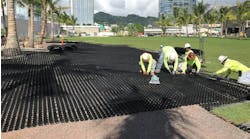
 |
Photo: North Carolina State University |
| Two North Carolina State University students installing plants on the green roof |
Getting
the green roofs well established may mean “we’ll need to simply require
irrigation systems to be installed on extensive green roofs,” he
concludes.
Gary
Langsdale, risk officer at Penn State, says that the university’s insurer did
not require it to pay any extra insurance premium for the green
roofs.
Ford
Stryker, associate vice president for Penn State’s Physical Plant, explains,
“Properly installed green roofs are less likely to
leak than a conventional roof. The soil and plants shield the roofing membrane
from ultraviolet rays that would break them down. For this reason, green roofs
can last up to twice as long as conventional
roofs.”
Long-Term
Costs and Benefits
When
people tell him that green roofs are too expensive to install, Berghage replies,
“‘Yes, they are too expensive, but the environmental and aesthetic benefits
outweigh the costs.’”
He
adds, “The relative cost benefit also depends greatly on where and why the roof
is being proposed—if it is part of the stormwater plan for a site, the cost of
other options may be higher.”
Rowe
notes that when research at Michigan State on green roofs started about eight
years ago, “most people had no idea what we were talking about. Today, people
are much more knowledgeable, but still skeptical. Initial cost is still a major
obstacle. However, over the long run, green roofs are less
expensive.”
The
initial higher cost of a green roof can seem less daunting when people realize
that “green roofs last two to three times as long as conventional roofs and are
more energy efficient,” Rowe says.
The
EPA’s Web site compares extensive green roofs at $8 per square foot to
traditional roofs at $1.25 per square foot. However, it notes, “It is widely
known that up-front costs do not tell the whole story. Taking into account
future summertime energy savings at the time of purchase brings the price of a
green roof closer to that of a traditional roof.”